
Finding Happy Valley Residents
Happy Valley has no single official list of every person who lives here. A useful record path depends on the question. An address first needs parcel and jurisdiction context. A recorded instrument can establish a property interest. A known court case can be checked through its case number and court. Older family research often needs county land records, library material, and historical place names together. Each source has a different scope, so a name match alone is not enough to identify a person or establish a current address.
Start with the narrowest public record. Keep the address, account number, legal description, date, and source with each result. That basic log makes it easier to separate two people with similar names and to retrace a conclusion later.
- Resolve a known street address in the county property or map tool.
- Ask Assessment & Taxation for owner-of-record information when the map result needs that authorized confirmation.
- Use the owner, legal description, or document details at Recording to inspect the title trail.
- For a person’s own electoral record, use Oregon My Vote; use the County’s lawful data-request route only where it fits.
- For an older household, test historical place names, archival holdings, and a verified regional directory before drawing a conclusion.
Happy Valley Resident Record Custodians
Most records relevant to Happy Valley are held by Clackamas County or Oregon rather than by one City office. The Recording Division preserves instruments affecting land. Assessment & Taxation supplies the property context and owner inquiry route. Elections administers registration and lawfully requested voter files. Those are different evidence types, not interchangeable resident rolls.
Clackamas Clerk Recording Division
1710 Red Soils Court, Suite 110
Oregon City, OR 97045
503-655-8551
Assessment & Taxation
150 Beavercreek Road, Suite 135
Oregon City, OR 97045
503-655-8671
For a County record outside a self-service system, Records Management routes a written request to the right department under Oregon Public Records Law.
Happy Valley Address Records Begin With a Parcel
AscendWeb Property Search is the practical first screen for a Happy Valley address. It allows an eight-digit account number or a required street address, with optional city, state, and ZIP fields. The County does not offer an owner-name tab. A result is useful for property-tax context, but it is not a household list. CMap adds mapped context, including tax maps, values, services, districts, hazards, and zoning, while the County keeps owner names off the public internet.
| AscendWeb field | How it works |
|---|---|
| Account Number | Eight-digit account or alternate map-account route. |
| Street Address | Required; the County gives 123% Main as a wildcard example. |
| City and State/Province | Optional address refinements. |
| ZIP/Postal Code | Optional refinement, not a ZIP-wide resident search. |
The AscendWeb interface shows the required-address path used for this first check.
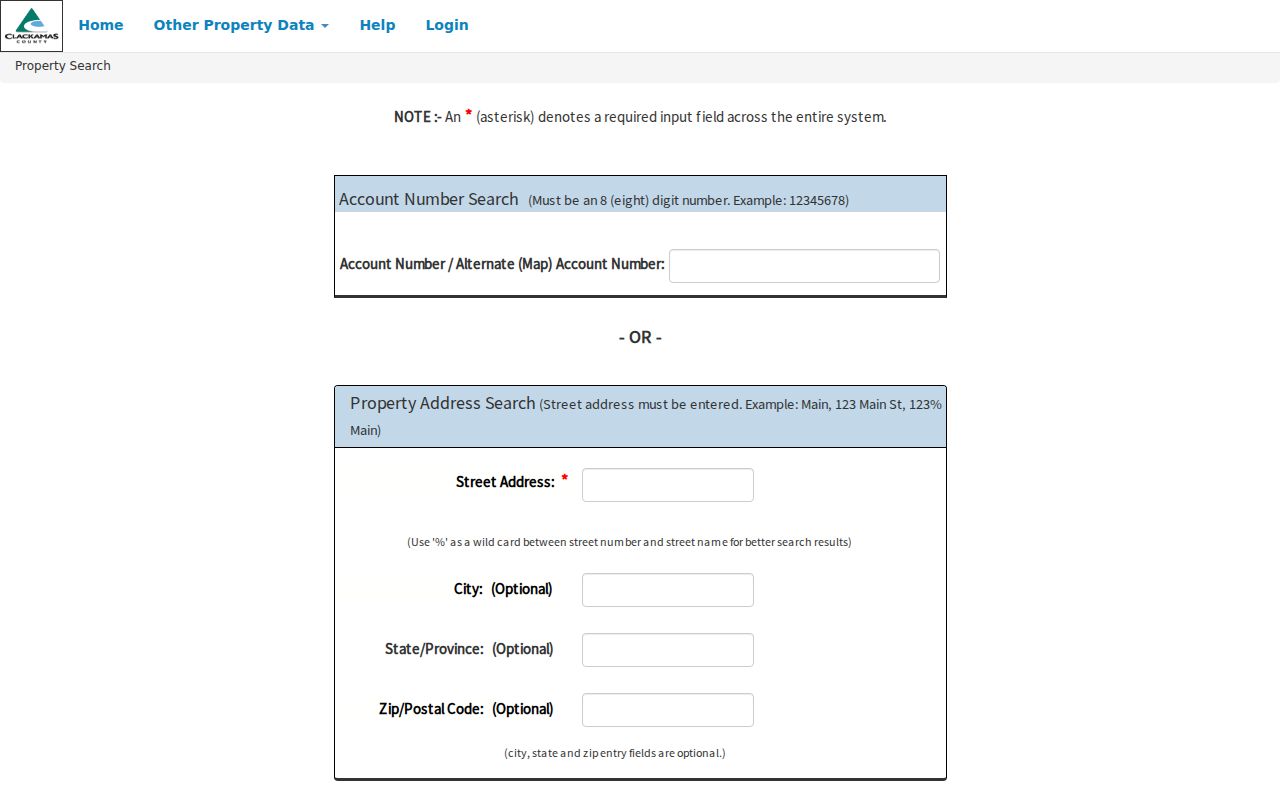
Once the address resolves, the account and legal-description trail can be taken to the County office when an owner-of-record question remains.
Happy Valley Recorder Title Trail
The Clackamas County Clerk says its ownership records reach to the early 1850s and preserves instruments on microfilm or computer image. The public research and copying area matters because open map and property interfaces do not publish owner names. Documents are currently indexed within two business days, but that notice does not establish a public online coverage date. Ask the office about the available index, images, books, or microfilm for the date in question.
A deed’s legal description is the durable bridge. It may use metes and bounds, a subdivision with lot and block, or a referenced book, page, or instrument. The tax lot or account is helpful but is not itself a legal description. Read the grantee on an acquisition deed, then look for that seller’s own prior acquisition. This turns a street address into a documented chain of property interests without claiming that every listed party lives there.
- Parcel
- A tax and map unit used to organize property information.
- Index
- A finding tool that points to a record; it is not always the record image.
- Grantor and grantee
- The party transferring an interest and the party receiving it.
- Legal description
- The recorded land description that can outlast a changed street address.
The Recording Division’s public research area is the documented local route for title and instrument inspection.
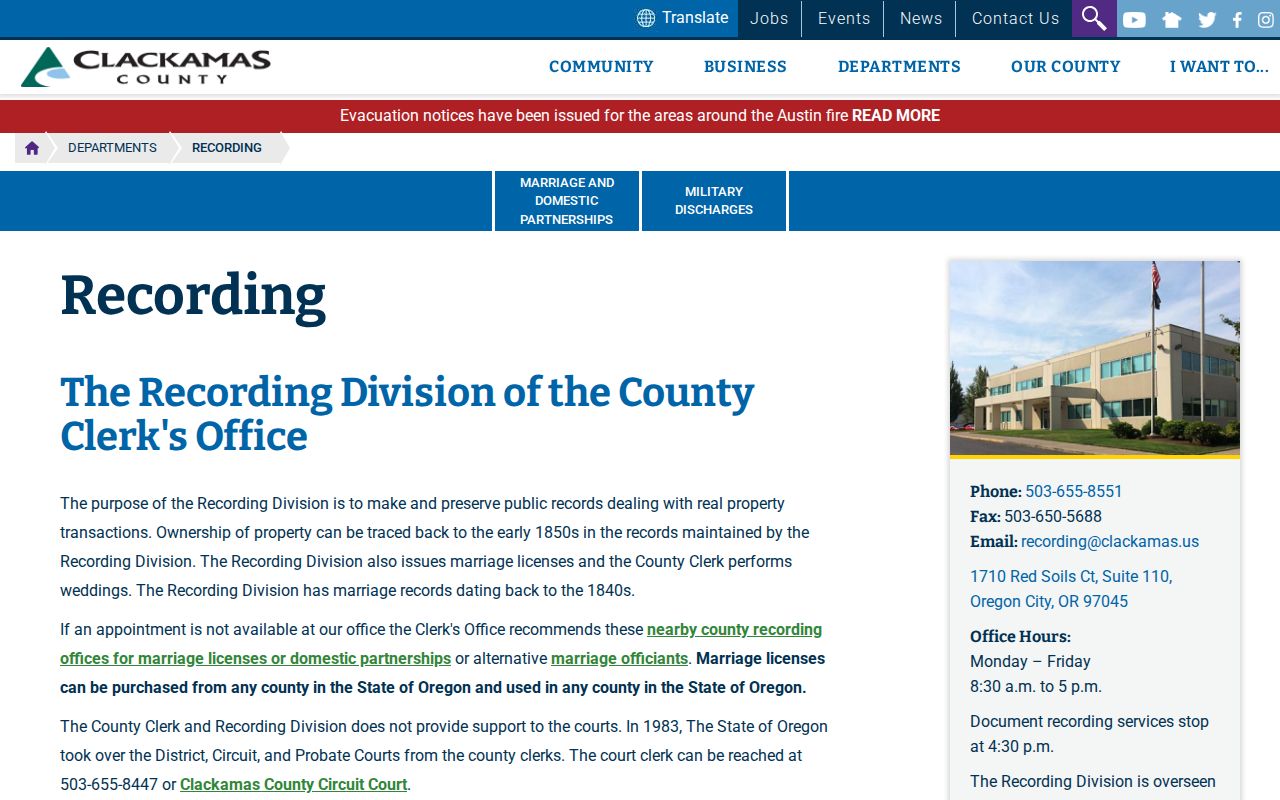
Record the document number, party roles, recording date, and legal description before moving to the prior transfer.
Note: A deed supports a recorded property interest, but it does not by itself prove a present household or every person at the address.
Current Happy Valley Resident Sources
Current Happy Valley resident sources each cover a limited slice. The County’s map and property systems establish a parcel. Recording documents show parties to a transaction. My Vote is a self-service tool for a voter’s own record, while County voter-list orders have statutory limits. The City’s HOA program is a connector for associations, not a public membership roster. For a one-person verification sequence, use the focused Happy Valley resident lookup route after identifying which record can answer the question.
| Local source | What it can show | Custodian | Access boundary |
|---|---|---|---|
| Address/account record | Parcel and assessment context | Assessment & Taxation | Address/account search; owner names are not online. |
| Recorded instrument | Named parties and property interest | Clerk Recording Division | Counter and research-area route. |
| Voter record | Permitted electoral fields | State and County Elections | Protections, form, fee, and use limits apply. |
| Municipal records | Defined City business such as agendas or liens | Happy Valley Recorder | Not a general resident roster. |
| Historic collections | Obituaries, maps, microfilm, and family material | CCFHS and CCHS | Coverage varies by place and period. |
Commercial compilation services may be stale, wrongly merged, or incomplete. Official records are stronger evidence because their custodian and limits are known, although they also need careful checking.
Historical Happy Valley Resident Directories
Historical Happy Valley directory research is regional by necessity. The City incorporated in 1965 after a long rural history, and the research did not verify a local run of city-directory volumes. That gap should be stated plainly. The Clackamas County Family History Society’s research library in Oregon City holds maps, microfilm, donation land claims, local obituary clippings, unindexed county vital and burial material, family histories, and vertical files. Its collection can connect a person or place to a much older County record trail.
Multnomah County Library documents a reverse Street and Avenue Guide in Portland directories from 1930 forward. It is arranged by street, block, and address, then can be paired with the alphabetical section. That is a useful method only after verifying that the address and period are actually covered. The fuller collection discussion belongs in the Happy Valley city directories section.
Note: A directory listing is a dated lead, so compare its spelling, address, and place name with deeds, census material, or obituaries.
Happy Valley Voter Records Stay Limited
Oregon My Vote is designed for a person to check their own registration, ballot status, officials, and County contact. The documented gateway uses a name and date of birth. It is not an open street browser. ORS 247.948 identifies certain public voter-file elements, while protecting items such as birth month and day, Social Security number, driver-license number, signature, Address Confidentiality Program data, and protected addresses. A missing result can reflect nonregistration, a protected record, or a different mailing address.
Clackamas Elections can fill lawful list orders by filters such as ZIP code, precinct, district, party, age, and voting-history options. Less-than-statewide orders require the County’s data request form. The County publishes a processing/media fee plus a per-voter amount, while ORS 247.955 restricts commercial use. Ballot choices are never part of the public file.
The Oregon My Vote entry page identifies the self-service route and its language choices.
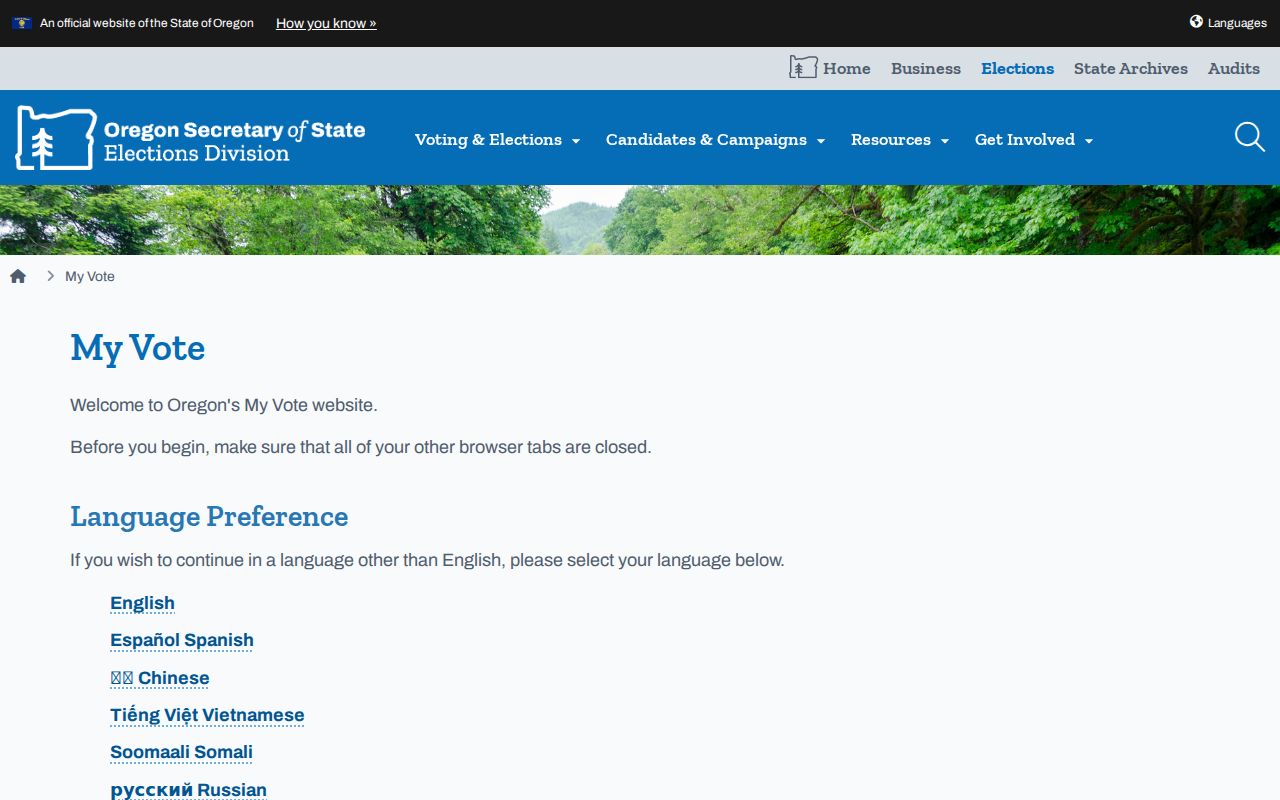
The screen is best used to check a voter’s own information, not to infer who is part of a neighborhood.
Happy Valley Court Records by Case
Happy Valley Municipal Court handles known citations and violations through a focused form. Clackamas County Circuit Court and Oregon’s court system are the routes for broader state trial-court matters. The free OJD Records and Calendar Search provides basic case and calendar information, while OJCIN Online is a registered subscription service. A party name in a docket does not establish a person’s current residence, identity, or responsibility for the matter.
The case register is the timeline of filings, hearings, notices, judgments, and reminders. It is not the same as the file documents. For records before December 2015, Circuit Court says to call at least three days ahead for off-site retrieval. Documents filed on or after December 4, 2015 have a public-station path at the first-floor Public Service Center, Room 1060. A copy request should specify the case name, case number, requested document, and whether certification is needed.
The OJD court-records page distinguishes the free basic search, OJCIN, and local-court access.
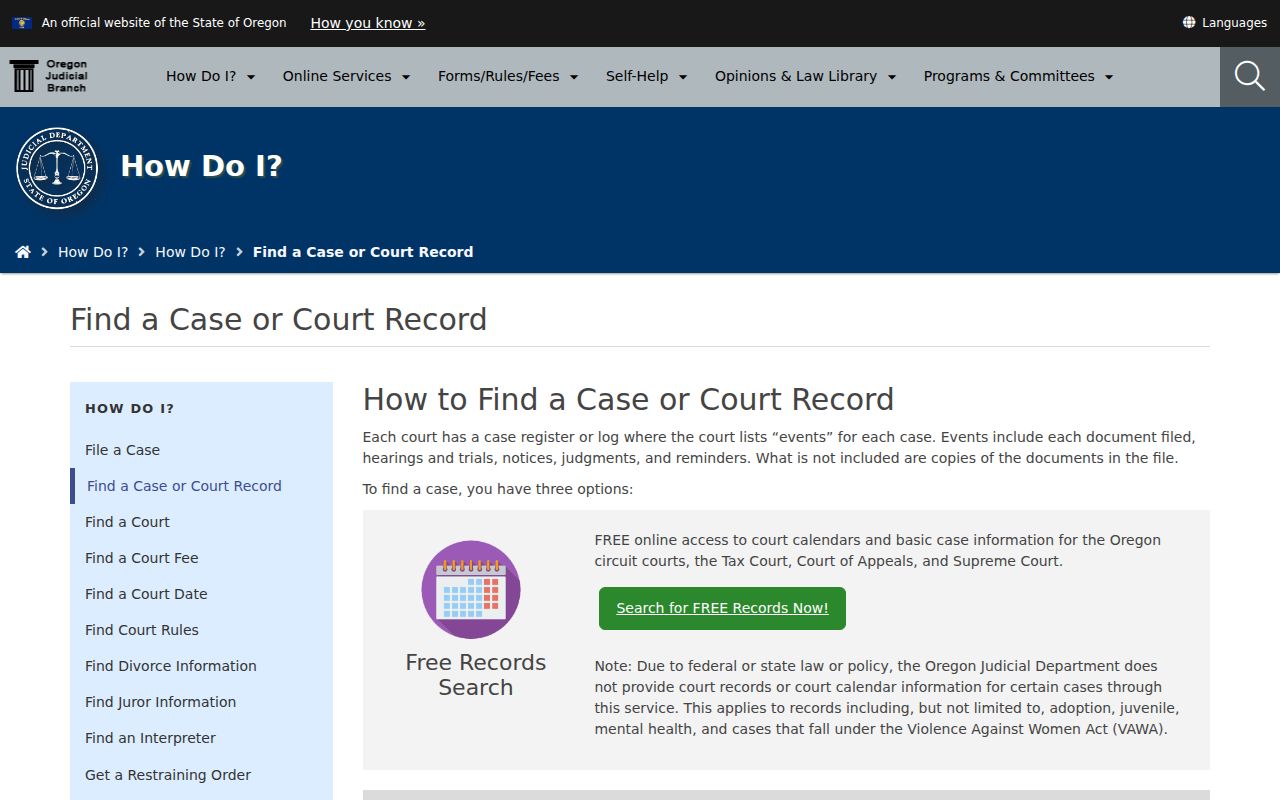
Confidential categories, sealed cases, and redactions can keep a matter out of an online result or require a court-specific request.
Happy Valley Names Before Incorporation
Older records may not use the modern City name. City history identifies Deardorff Settlement or Valley, Happy Hollow, Christilla Valley, and East Mount Scott as earlier terms for the area. Happy Hollow appears on 1912 and 1926 County surveyor maps, and the research locates Happy Valley in 1909 acreage advertising. Incorporation came in 1965. Search those place names with a person, landmark, street form, legal description, or township-range-section reference when a modern-name query stops short.
This is especially important for land and family work. The State Archives identifies Clackamas deed indexes from 1850 to 1859, as well as deed records beginning in 1855. The Clerk’s broader land trail reaches into the early 1850s. A later subdivision name or street number can be less useful than the legal description found in an early transfer.
Happy Valley Archive and Cemetery Clues
The Clackamas Historical Society digitized collection offers more than 10,000 photos and supports exact phrases in quotation marks, plus signs to join terms, and asterisk wildcards. An exact phrase such as a historic place name can separate a local result from general words. Volunteer-created descriptions can contain errors, so test a caption against a deed, map, obituary, or other independent record.
Christilla Pioneer Cemetery is another local history lead. The City reported its public reopening in 2025 after restoration and described an 1852 founding with 29 marked graves. It is not a searchable burial database. Use the City history material, CCFHS obituary and burial holdings, and cemetery contacts to seek documented information rather than treating a historic reference as proof about a family.
Happy Valley ZIP Records Need Two Checks
Happy Valley’s City-stated ZIP is 97086, but a ZIP is a postal-delivery label, not a City boundary. USPS established 97086 on July 1, 2006 from portions of 97015, 97009, and 97236. City sources also use 97015 for the Happy Valley Library. First verify the exact street address through USPS, then use CMap or the City boundary information for jurisdiction. A mailing or tax-statement address can also differ from the physical situs address.
AscendWeb accepts an optional ZIP after its required street address. That narrows an address check, not a whole-ZIP property roll. The County voter-list request does include ZIP as a filter, but it is a formal and protected data route. The USPS Postal Bulletin notice documents the 2006 change behind this local mismatch.
Happy Valley Records Requests When Portals End
When a specific County record is not online, Clackamas County Records Management accepts a written request at recordsmanagementinfo@clackamas.us and routes it to the responsible department. Identify the record, date range, address or account, department, and preferred format. The County says it acknowledges requests within five business days, gives a time estimate based on scope and difficulty, and may charge actual costs for search, review, redaction, copying, or delivery. Asking for a defined record works better than asking an office to perform open-ended research.
The County public-records request route explains the form, cost, and department-contact process.
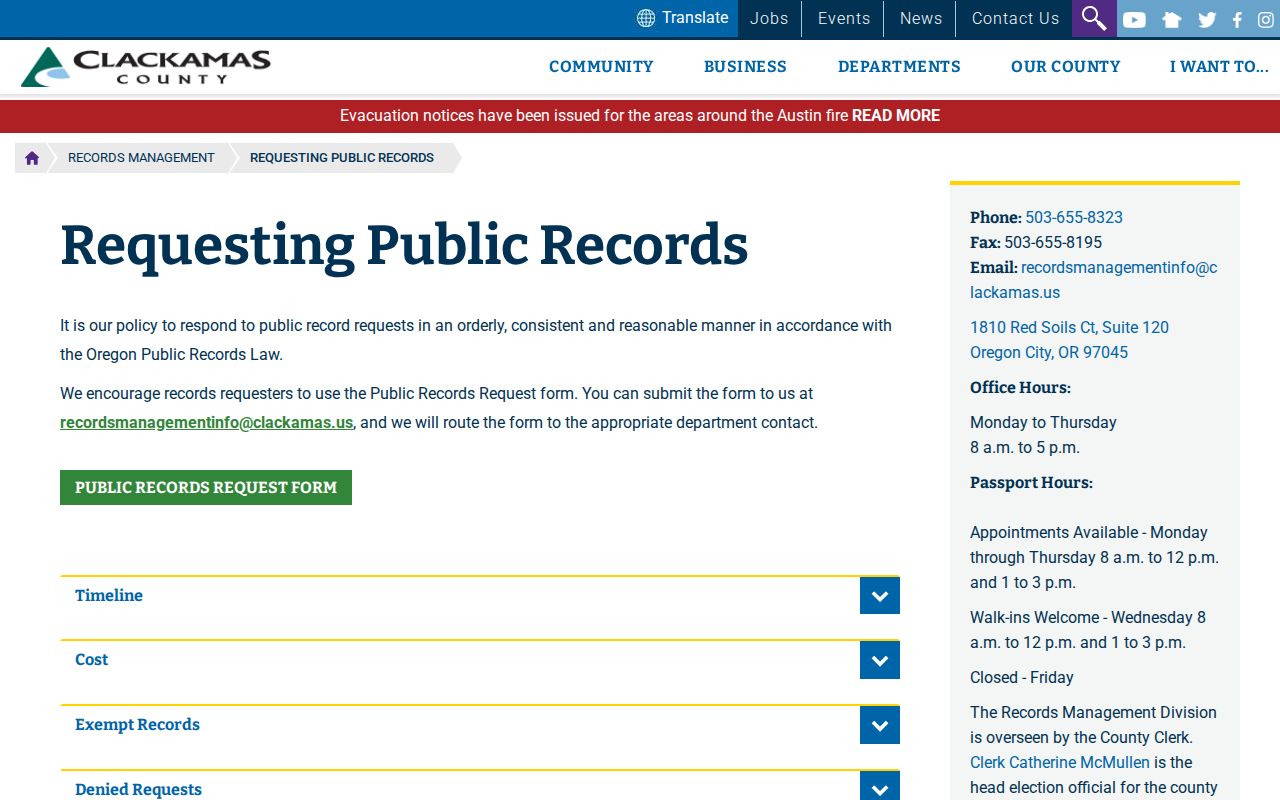
Oregon Public Records Law allows access to nonexempt records, but it does not require a custodian to create a new record or solve an unexplained identity question.
Happy Valley Vital Records Need Time Checks
Vital records are evidence of an event or relationship, not a current resident roll. For a Happy Valley event, the Clackamas County Health Department holds certified birth and death events only for the first six months. After that window, Oregon Vital Records is the usual certified-copy route. The County Recording Division holds county marriage material, while Oregon can provide a marriage summary through its statewide system. A court file and a state vital certificate are separate sources for a divorce or dissolution.
Oregon closes birth records for 100 years and death, fetal-death, marriage, domestic-partnership, divorce, and dissolution records for 50 years. During those periods, a certified-copy applicant must meet the stated eligibility rules and provide identification. The official base charge for a mail, drop-box, or appointment request is $25 for the initial search and first certificate, and the search is nonrefundable after it begins. Online and phone routes add fees. Confirm the current amount and document requirements before ordering.
For a historical family question, the opening period does not mean every old record is immediately searchable online. Oregon State Archives and county repositories hold particular series, books, and microfilm. Record the event place, approximate date, relationship, and name variants before choosing a custodian.