
Happy Valley Previous Residents by Era
Previous residents research works best as an era map. The current address first resolves to a tax account, parcel, and legal description. From there, the Clackamas County Clerk Recording Division can supply the ownership trail, while historical repositories help with older names and household clues. The county’s public online property tools show useful map and tax context, but they deliberately do not publish owner names. Ask Assessment & Taxation for the owner-of-record path, then use the Recording Division’s public research area for the transfer trail.
| Source | Years It Covers | Where Held | What It Shows |
|---|---|---|---|
| Clerk land-record trail | Early 1850s to current | Recording Division public research area | Successive owners, interests, and the legal description. |
| State Archives deed index | 1850-1859 | Archives guide and microfilm | Alphabetical grantor/grantee entries, township/range/section, book and page. |
| State Archives deed record | 1855-1859 | Microfilm Reel 2 identified in the guide | Transfer text fields and recording chronology. |
| Federal census | Public through 1950 | National Archives and genealogy access | A dated household snapshot, not continuous address history. |
| Portland-area reverse directories | 1930-present where coverage is verified | Multnomah County Library | Street, block, and address listings in covered volumes. |
| City or county permits | Electronic era; historic start not verified | HVWorks or County ACA | Construction, alteration, or site-project timing. |
Use the dated transfer chain as the backbone. Directories and census records can fill gaps, but only after confirming that the relevant address lies within the collection’s coverage. For newer subdivision homes, permit history may answer a timing question more directly than an older directory can.
Note: A property owner, a tax mailing address, and a household occupant are different facts that should be recorded separately.
Happy Valley Past Residents House File
Begin with the present situs address in AscendWeb Property Search or with an address, city, intersection, tax lot, or parcel lookup in CMap. AscendWeb accepts an eight-digit account or a required street address, with city, state, and ZIP as optional fields. CMap adds map, district, service, tax-map, and parcel context. Neither public interface is an owner-name search.
For a recorded-owner question, the County directs researchers to Assessment & Taxation by phone, email, or counter. Preserve the parcel or account number, situs address, tax year, and the exact question asked. The result is a property-interest lead, not a claim that the named party lived at the address. Next, record the subdivision, lot, block, map number, or other legal-description clues before checking a deed.
For previous residents research, those identifiers are the stable starting record. They reduce the risk of joining a modern address to a different lot, plat, or similarly named property.
The Clerk Recording Division preserves real-property records on microfilm or computer image and maintains a public research and copying area. Its public statement places the local ownership trail in the early 1850s, providing the appropriate counter route when a modern map result is only the starting point.
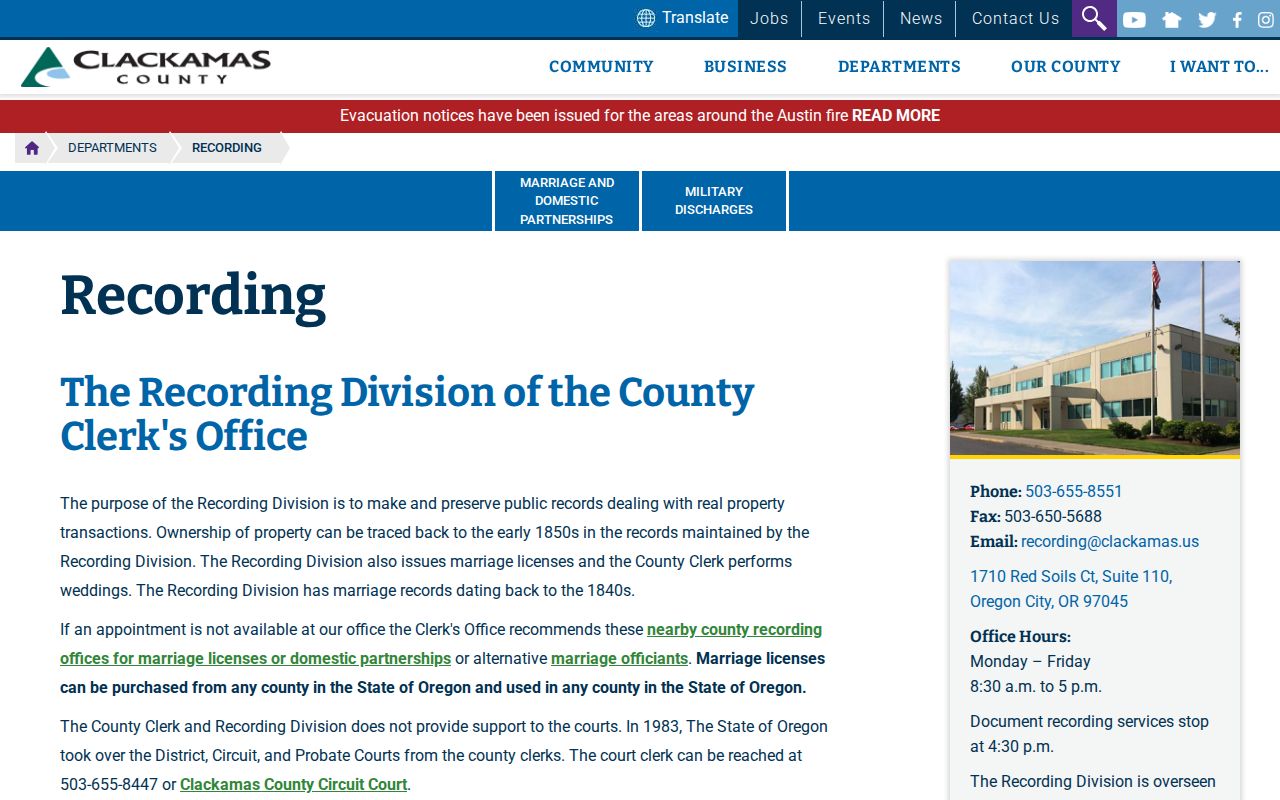
The Recording Division image reinforces the split between an online map lookup and the source needed to inspect historic title material. Keep a research log with the exact spelling, document number, recording date, source, and legal description for each transaction.
Trace Previous Residents Through Clackamas Deeds
The deed chain is a backward sequence, not a name search run once. Locate the present owner through the authorized County path, identify that owner’s acquisition instrument, and inspect its party names and legal description. The seller on that transfer is usually the next person to test as a prior grantee. Search both personal-name variants and any trust, estate, or entity name that appears in the record. A street address can change; a legal description often preserves the link across that change.
- Resolve the current Happy Valley address to its account, parcel, subdivision data, and legal description.
- Request the owner-of-record information through Assessment & Taxation, using the address and tax year precisely.
- At the Recording Division, inspect that party’s acquisition deed and log its grantor, grantee, date, document reference, and legal description.
- Search the seller or prior owner as grantee to find the earlier purchase, then repeat the same documentation steps.
- For older material, ask about the grantor/grantee index, books or reels, and image availability for the date and legal description. The public research did not verify an online indexing cutoff.
- Grantor
- The party transferring an interest in land in the recorded instrument.
- Grantee
- The party receiving that recorded interest. Searching a former owner in this role can reveal an earlier acquisition.
- Chain of title
- The documented sequence of recorded transfers or interests associated with the same property.
- Legal description
- The land description used in a recorded document, such as metes and bounds, a subdivision and lot/block, or a referenced instrument. A tax account alone is not a legal description.
Keep the legal description beside each deed reference. A lot and block, metes-and-bounds description, or incorporated instrument reference can connect the same property when an older record uses a rural place name or a later address has different wording.
Happy Valley Property Records Before 1850
Past residents research can move before Happy Valley existed as a city. The Clerk says its real-property trail reaches into the early 1850s. The Oregon State Archives territorial guide identifies Clackamas deed indexes for 1850-1859, arranged alphabetically by grantor and grantee, and deed records from 1855-1859. The indexes can carry township, range, section, property description, and book or page references.
The exact online start date for the County index, its image cutoff, and the fields available on a current microfilm machine were not documented in the public sources reviewed. That uncertainty matters. Call the Recorder before a research trip and ask about the target date, grantor/grantee index, books or reels, and the legal description. Expect a counter or microfilm step for older title work rather than assuming every early record is searchable online.
Note: The early deed-series dates are documented, but no current online coverage cutoff was verified for the County index.
Happy Valley Past Residents by Old Names
Who lived here before may be filed under a different place name. The City’s history identifies Deardorff Settlement or Valley, Happy Hollow, Christilla Valley, and East Mount Scott as earlier names for the landscape. Happy Hollow appears on 1912 and 1926 County surveyor maps, Happy Valley appears in 1909 acreage advertising, and municipal incorporation came in 1965. A modern city-name search alone can therefore miss a relevant land, map, newspaper, or collection reference.
Use the legal description, township/range/section, land-claim terms, nearby Mount Scott or Scouters Mountain references, and the Deardorff surname to bridge older material. No Happy Valley-specific street-renumbering project or year was verified. The safer conclusion is that historical place vocabulary, rather than a presumed renumbering event, is the documented continuity issue.
Happy Valley Past Residents Between Deeds
Recorded ownership does not establish who lived in the house in each interval. For a verified address within regional coverage, the Portland reverse Street and Avenue Guide has been arranged by street, block, and address from 1930 forward. Use the volume to find the address listing, then check the name-arranged section and retain the original spelling and street form. The regional method is useful only after a librarian confirms coverage for the target address and year.
- Match a verified reverse-directory year to the target address and preserve the address form shown in the volume.
- Choose the nearest public federal census, which reaches 1950 as of this research date, and treat it as a single household snapshot.
- Compare the names and address details with the deed timeline instead of replacing it with the directory or census entry.
- Use newspaper, obituary, and probate references as corroborating leads when a dated household transition needs support.
The documented collections and their coverage cautions are described in the Happy Valley city directories. They are especially useful when the property trail is known but the household picture is incomplete.
Note: A census is a dated household snapshot, while a reverse directory requires verified collection and address coverage.
Happy Valley Past Residents Archive Clues
The Clackamas County Family History Society operates the Family History Research Library in the Wilmer Gardner Research Library in Oregon City. Its documented holdings include maps, microfilm, donation land claims, local obituary clippings, unindexed county vital and burial material, family histories, and subject or surname vertical files. Access is free with donations appreciated. Published hours include Wednesdays and the first and third Saturdays when the museum is open, but the page also contains an older appointment note, so call before making a special trip.
The Family History Research Library’s holdings page is the direct source for this local Clackamas fallback when an address trail needs a map, obituary, burial, or family-file lead.
These materials can provide context for a person in the title chain, but the underlying deed, directory, obituary, or probate source remains the record to cite for a specific conclusion.
The Historical Society’s digitized collection offers a separate place-name route with more than 10,000 photographs. Exact-phrase, plus-term, and wildcard searching can help test “Happy Valley” alongside earlier place names, and captions should be cross-checked because volunteer-created descriptions can contain errors.
The Historical Society collection search documents those search mechanics and the request route for non-watermarked photographs.
Use a digitized image as a lead to a place, street, or family spelling, then return to recorded land material or another primary record before linking it to a particular house.
Previous residents findings should preserve both the original caption or search term and the primary record used to confirm the connection.
Happy Valley Past Residents and Permits
For a home shaped by the city’s later subdivision growth, permit history can date construction or alteration more effectively than a historic directory. Happy Valley’s Civic Access guidance supports searches by known permit number or site address, while the County ACA portal is the secondary route for the proper county jurisdiction. Confirm the parcel’s jurisdiction before choosing a channel, because a Happy Valley postal address and City limits are not the same thing.
At the other end of a historical trail, the Family History Library’s obituary clippings, local burial material, and maps may provide useful context. Christilla Pioneer Cemetery is a local history lead, not a searchable cemetery index. The City reported its restoration and public reopening in 2025, with 29 marked graves. Probate can also identify an estate representative or heirs, subject to court access and privacy rules.
Note: Confirm City versus County permit jurisdiction before treating a site-address result as the property’s complete construction history.
Happy Valley Resident History Respectfully
Past residents research is most useful for family history, property history, estate questions, and local-history curiosity. It should remain focused on recorded property interests and documented historical sources. A tax mailing address, recorded owner, business entity, or directory entry cannot establish every person who occupied a home, and protected records remain protected even when other parcel material is public.
Lawful use. Use Happy Valley house-history records for personal, respectful research. Do not use a historic address trail to watch, harass, intimidate, or harm any living person.
When the record only identifies an owner or a parcel, describe it that way. A careful history separates a confirmed transfer from a household clue and leaves protected or unverified details out.